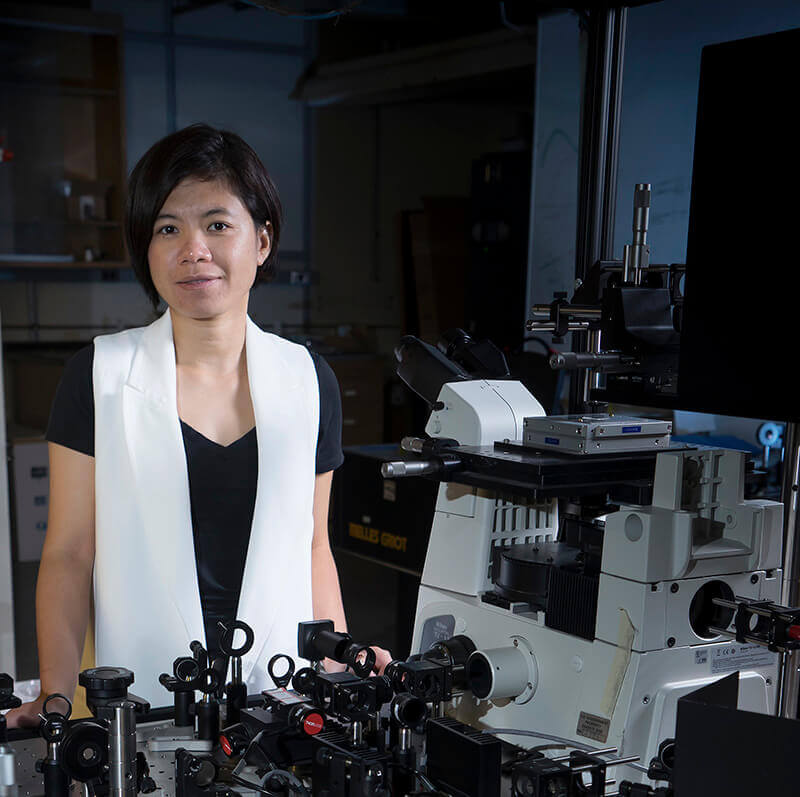
 Tarpo Professor of Chemistry Libai Huang recently sat with us to answer some questions about her background, her research, her new position as Director of QuPIDC, and the interdisciplinary collaborations that make her work possible.
Tell me about yourself. What initially drew you to the intersection of chemistry and quantum science, specifically working with molecular and two-dimensional materials?
I am a physical chemist by training, and I have always been fascinated by the question of how microscopic interactions ultimately determine the properties we observe in materials. My group develops ultrafast optical imaging and spectroscopy methods that allow us to actually watch energy and quantum information move through materials in space and time.
Molecular and two-dimensional materials are particularly exciting to me because they give chemists an extraordinary degree of control. We can change molecular structure, composition, interfaces, stacking, or local environment and fundamentally alter how excitons and other quantum states behave. That creates an opportunity not only to observe quantum phenomena, but to design materials in which those phenomena can be controlled. That intersection between chemical design, quantum dynamics, and advanced optical measurements is where I find some of the most interesting scientific questions.
Could you share what the journey was like stepping into the role of Director for a Department of Energy (DOE) Energy Frontier Research Center like QuPIDC?
Becoming Director of QuPIDC was both exciting and a major transition for me. As an individual PI, you naturally think deeply about the scientific questions in your own laboratory. Directing an EFRC requires thinking at a very different scale: What can a team accomplish that none of us could accomplish independently?
QuPIDC brings together researchers with very different expertise, from materials synthesis and ultrafast spectroscopy to quantum optics, nanophotonics, and theory. My role is not to tell everyone what experiment to do. It is to help create a scientific framework in which these different capabilities reinforce one another. I have learned that directing a center is really about building connections—between people, between disciplines, and between ideas.
I have also learned an enormous amount from everyone on the team. Working closely with scientists who approach problems from very different perspectives has helped me see how many of the most important questions lie at the interfaces between disciplines. A materials scientist, a quantum optical physicist, and a theorist may look at the same problem in completely different ways, and bringing those perspectives together can change the questions we ask. That experience has also given me a very different perspective on my own research and has pushed me to think beyond the approaches and assumptions that are most familiar to me.
When these connections work well, you begin to see new research directions emerge that were not obvious when the center started. For me, that has been one of the most rewarding aspects of directing QuPIDC, not only seeing what we can accomplish collectively, but also seeing how much we can learn from one another.
Your research involves imaging exciton propagation and interactions with incredible precision. What is the most challenging aspect of capturing quantum phenomena at this scale?
The fundamental challenge is that interactions between excitons occur simultaneously over extremely small spatial scales and extremely short timescales. An exciton can evolve on femtosecond or picosecond timescales while moving only nanometers to micrometers. At the same time, the material itself can be highly heterogeneous. If you only measure an average signal, many important quantum behaviors disappear. We have invested so much effort in developing imaging approaches that resolve both space and time. Quantum states can be fragile. Ultimately, we want to go beyond simply measuring populations and transport and develop ways to visualize coherence, correlations, and interactions directly.
You focus heavily on the control of “coherent pathways.” For our readers who might not be experts, how does controlling these pathways impact the future of solar energy?
One way to think about coherent transport is that the particles move in sync, in a wave-like manner, allowing energy to propagate rapidly through a material with no scattering. In incoherent transport, by contrast, particles lose that synchronization and move more randomly, often by hopping from one site to another. Coherent transport can therefore be much faster and more efficient, but it is also more fragile because interactions with the environment can quickly destroy the coherence.
In real materials, these two types of transport often coexist, and the interplay between coherent and incoherent pathways can be extremely important. If we can understand how molecular structure, interactions, and the surrounding environment control the balance between these pathways, we can begin to design materials that preserve coherence where it is beneficial. Ultimately, this could allow us to guide excitation energy toward the outcomes we want, for example, more efficient charge generation or other useful photochemical processes.
How do the molecular and two-dimensional material frameworks you study offer advantages over other materials when it comes to advancing quantum information technologies?
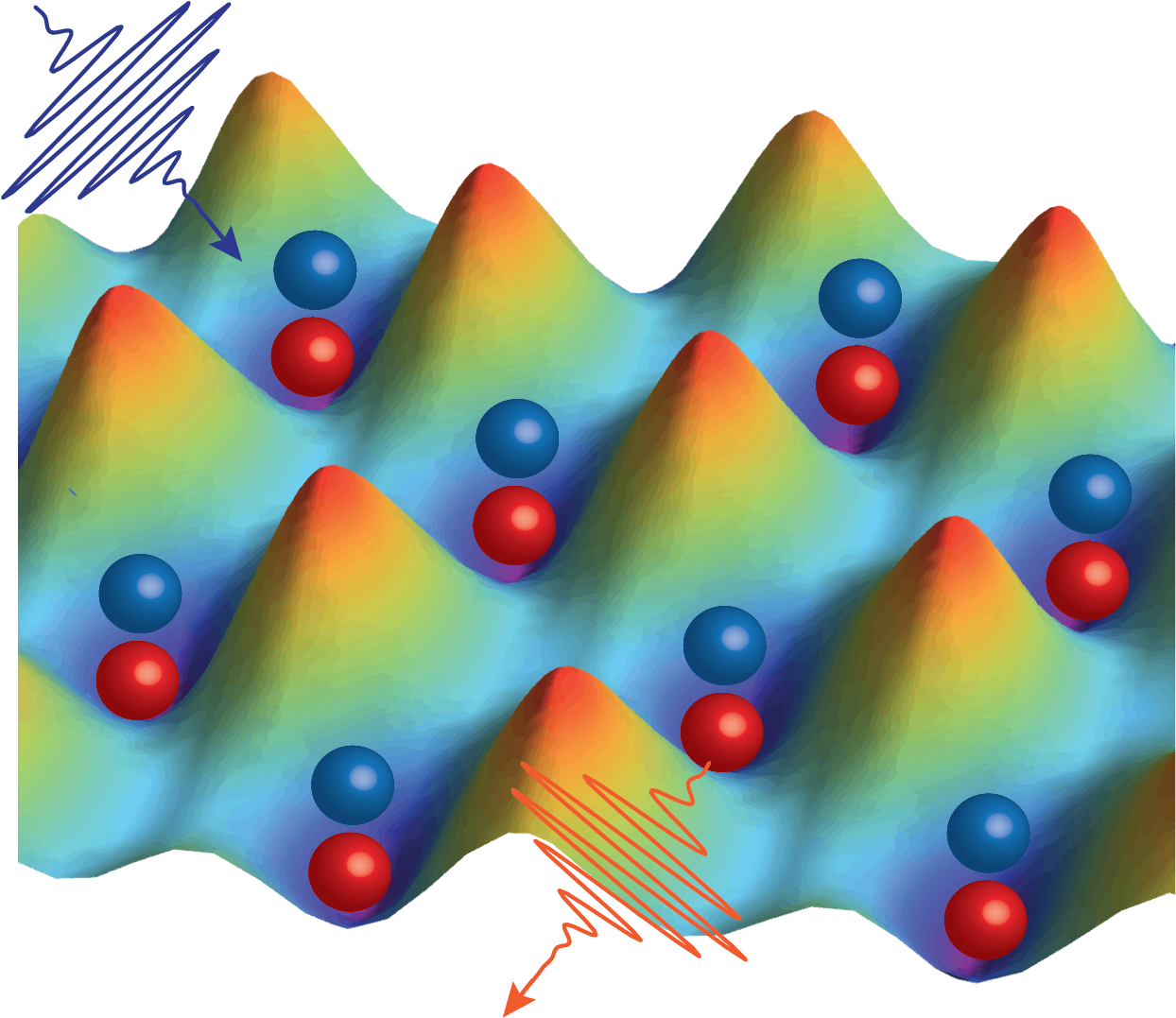
Photo credit: Libai Huang
They also provide access to strong interactions. Excitons in low-dimensional materials can interact strongly with one another and with photons, phonons, spins, and their surrounding dielectric environment. Those interactions can a become resources for creating nonlinear optical responses, correlated states, and entanglement.
QuPIDC focuses on overcoming scalability challenges in quantum photonic systems by leveraging, rather than just eliminating, the “imperfections” in solid-state materials. Can you explain the philosophy behind this?
There is a natural tendency in quantum science to think that the ideal material should be perfectly uniform. If every quantum emitter were identical and every environment perfectly controlled, many things would certainly be easier.
But real solid-state materials are not like that. Emitters have different transition energies, local environments fluctuate, interfaces are imperfect, and interactions vary spatially. If the only path toward scalable quantum technology requires eliminating all of those variations, scalability becomes extremely difficult.
QuPIDC takes a different approach. We ask whether we can design the entire system—the emitter, its photonic environment, the interactions among emitters, and the control protocols—so that it can function in the presence of realistic materials complexity. The goal is therefore not simply to fabricate a perfect material; it is to create a quantum architecture that is robust enough to work with real materials.
One of the most fascinating aspects of QuPIDC’s approach is that you are leveraging the complexity and imperfections, like inhomogeneities, of solid-state materials rather than just trying to avoid them. Could you explain a bit more about this?
Inhomogeneity is a good example. Suppose you have many quantum emitters, but they are not all exactly the same color. The conventional approach might be to spend enormous effort trying to make every emitter identical.
We ask another question: Can the photonic structure and quantum-control strategy be designed to accommodate that distribution? Can we selectively connect emitters, tune their interactions, or use the available spectral complexity as part of the architecture?
This represents a broader change in perspective. Instead of separating the materials problem from the device problem, we treat them as a coupled design problem. Once you do that, something that looks like an imperfection at one level may become a useful design parameter at another.
A major goal of the center is the “co-design” of quantum emitters and nanophotonic structures. What does that collaboration look like in practice across different disciplines like quantum optics and ultrafast spectroscopy?
Co-design means that we do not optimize the material first and then hand it to someone else to build a photonic device around it. The materials, photonics, spectroscopy, quantum protocols, and theory have to inform one another from the beginning.
For example, ultrafast spectroscopy might reveal how an exciton interacts with other excitons or loses coherence. Quantum-optical measurements tell us about photon statistics and emitter–photon entanglement. Nanophotonics can then modify the electromagnetic environment to enhance particular interactions or emission pathways. Theory connects these observations and helps identify which parameters matter most.
The process is iterative: make, measure, understand, design, and make again. That is what we mean by co-design. The strength of an EFRC is that the people performing each of those steps are part of the same scientific conversation.
Looking ahead to the next four years, what breakthrough or milestone developed through QuPIDC’s theoretical and experimental tools would you be most proud of?
I would be most excited if we could demonstrate that this co-design philosophy genuinely changes what is possible in solid-state quantum photonics.
A major milestone would be to start with realistic, heterogeneous solid-state quantum emitters and use engineered photonic environments and many-body interactions to generate and control nonclassical states of light at a scale that would be difficult to achieve by treating each emitter independently.
But I think the longer-lasting outcome would be a set of predictive design rules. If QuPIDC can show how materials properties, emitter interactions, photonic structures, and quantum protocols should be designed together—and provide experimental validation of those principles—that framework could continue influencing the field well beyond the lifetime of the center.
Has your affiliation with the Purdue Quantum Science and Engineering Institute (PQSEI) amplified the research you are doing, or the funding you are able to seek? If so, how?
Absolutely. Quantum science increasingly requires expertise that crosses traditional departmental boundaries. PQSEI provides an intellectual and organizational environment where researchers in chemistry, physics, materials science, engineering, photonics, and quantum information can interact much more naturally.
That community is particularly valuable for research like ours because many of the most interesting questions sit precisely at those boundaries. It creates opportunities to identify collaborators, share capabilities, develop new scientific directions, and assemble teams capable of competing for large interdisciplinary programs.
QuPIDC itself illustrates why that ecosystem matters. A center focused on quantum photonic integrated systems cannot be built around one discipline or one laboratory. Having a strong quantum community at Purdue makes it possible to think at that larger scale.
What else should I know about your work, the QuPIDC project, and your connection to PQSEI?
One aspect of our work that I think is important is that we are trying to connect very fundamental science with a long-term technological challenge. But we are asking these questions with an eye toward a larger goal: learning how to build quantum systems from real materials.
For me, that is also what makes the combination of QuPIDC and PQSEI exciting. QuPIDC gives us a focused scientific mission and a highly integrated team, while PQSEI connects that effort to a much broader quantum community at Purdue. Together, they allow us to approach quantum science not simply as a physics, chemistry, or engineering problem, but as a materials-to-systems problem. I think that is where many of the important advances in scalable quantum technology will come from.